Muddy Water Treatments
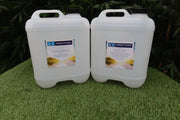
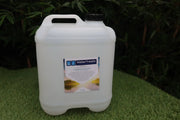
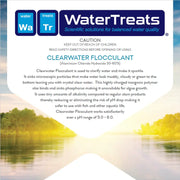
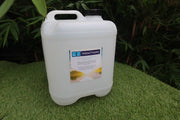
Take care of your muddy water issues once and for all with our industry-leading flocculant solution. Choose from a variety of measurements depending on the size of dam, pond, or water body. All of our products are safe for fish and other forms of wildlife and won't cause damage to the exterior of your water system. If you're not sure where to start, start off with our one litre trial bottle to test how much you'll need.
Flocculant - What is It and How Does it Work?
The purpose of using a flocculant is to remove dissolved inorganic matter from the main body of a water system. These particles need to be inorganic materials such as clay, silt, and sand rather than organic matter such as algae and plant debris.
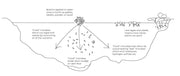
When left alone, particles from this suspended material carry a negative charge, which means they repel one another in the water (and therefore can't clump together). Flocculant neutralises this electrical charge, meaning that once particles begin to come into contact after treatment, they are able to stick together.
Eventually, as more and more of these clumps begin to form, they become heavier to the point where they start to sink to the bottom of the water. This leaves the main body looking clean and clear.
Testing How Much Flocculant You Need
Applying flocculant can actually be quite a tricky balancing act, so it's important you have a clear understanding of how much product you'll need to apply to your water body before you apply it.
Too little product, and the fine particles won't clump effectively, and your water will remain muddy. However, too much product can also be an issue - it can actually result in particles restabilising, as well as leading to potential issues with excess sludge and shifting pH levels.
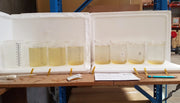
To counter this, we recommend testing your dosage using smaller amounts of your pond water, and applying incremental doses across multiple testing jars until you achieve your desired results. You can then extrapolate these results to match your main water volume.
FAQs
How does water become muddy?
Clear water will become muddy when sediment from banks and edges runs into the water, or if soil erosion takes place. This is usually caused by excess rainwater and adverse weather. You can add marginal plants to the edges of your water system to try and counter this runoff.
Can flocculant be used in any body of water?
Yes. Flocculants can remove suspended particles from any body of water. This includes saltwater (though there are additional considerations for these setups). It is particularly effective at settling water bodies with excessive phosphorus.
What can I do if I've used too much flocculant?
Stay calm - the process is reversible. You should allow for settling time to see the extent of the issue. You can then look to remove some of the settled sludge, as this is where the solution will still largely be concentrated. You can perform a partial water change to remove the excess still lingering in your main body. And you can increase aeration if you have a system set up.
Is coagulation the same as flocculation?
They are not the same, but they are both involved in this process. Coagulation is the chemical reaction of neutralising the electrical charges on suspended particles. Flocculation is the physical act of the particles clumping together. You can manually encourage flocculation, but not coagulation.
What can I do to remove organic material?
For organic material, you should consider setting up an aeration system to help increase oxygenation, which will then help to limit algae growth and decomposition. Alternatively, you could use our Biostim solution which helps to encourage the growth of beneficial bacteria which will starve algae and other weeds.